
The Brain Care Score (BCS)
A New Test/Guide to Assess Brain Health and Actively Care for it to Reduce the Risk of Dementia and Stroke.

SUMMARY
The Brain Care Score (BCS)
The Brain Care Score has been developed to evaluate the Future Risk of developing Dementia and Stroke (Brain Diseases).
Currently, one in seven (1:7) people has Dementia (US), a number that is expected to Triple by 2050. Additionally, One Stroke-related Death occurs every 4 minutes, and by 2050, there will be 13 million deaths annually attributable to new cases of Stroke.
Epidemiological studies have shown that up to 40% of Dementia cases and at least 60% of Stroke cases have been attributed to Modifiable Risk Factors, implying that many of them are Preventable.
Furthermore, many of the modifiable risk factors for Stroke and Dementia are shared between these diseases.
The Brain Care Score (BCS) was designed to provide a Simple Tool to motivate patients and their doctors to modify risk factors and reduce the risk of developing Common Age-related Brain Disorders (Dementia/Stroke).
Researchers from the McCance Center for Brain Health (USA) conducted the study to validate the designed Brain Care Score (BCS) for the First Time, using data from approx 400,000 adults aged 40 to 69 years from the UK Biobank.
To design the Brain Care Score (BCS), the authors selected the most Common and Well-known Modifiable Risk Factors for Dementia and Stroke, widely and repeatedly endorsed by Professional Societies.
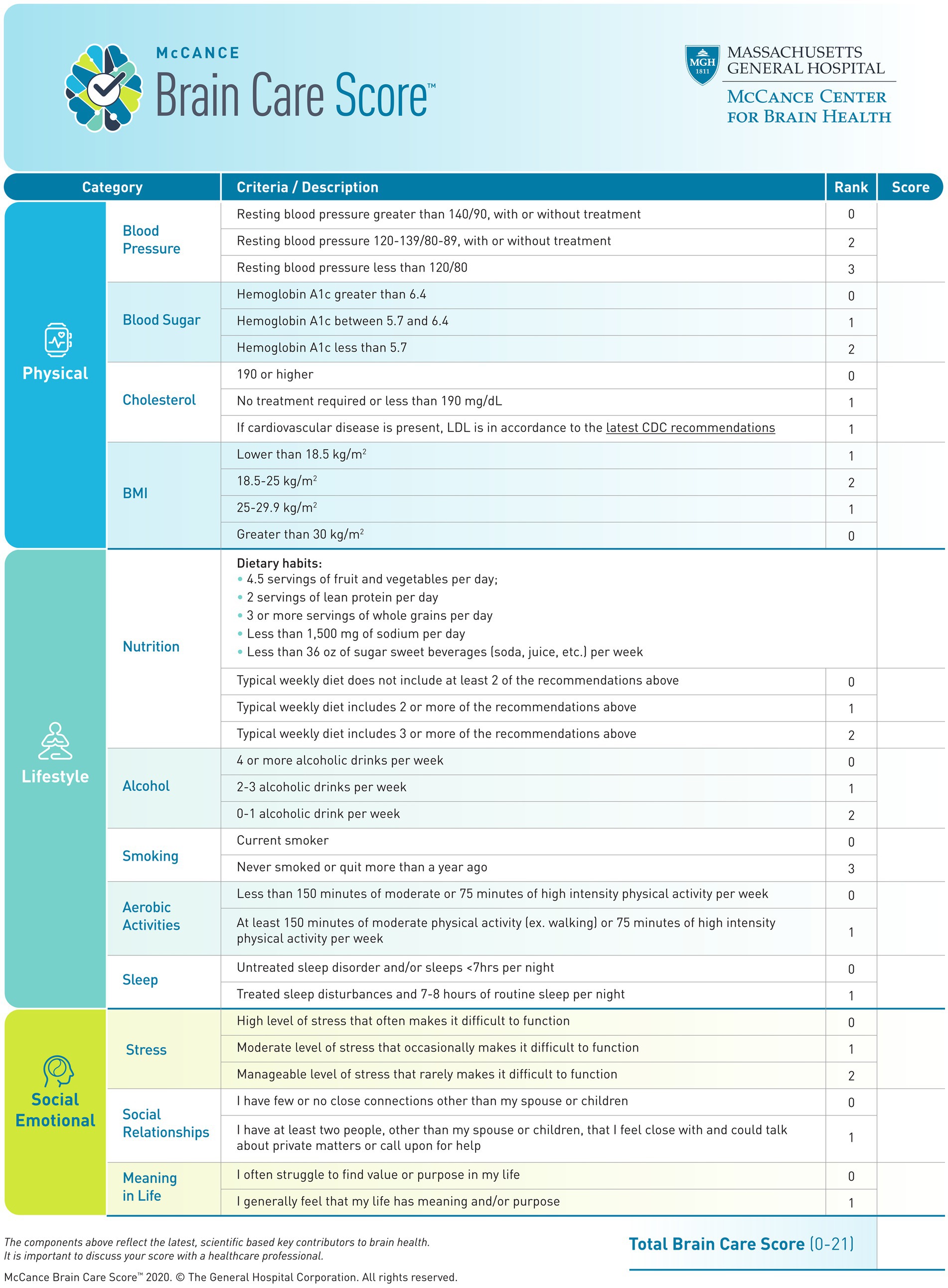
During the design of the BCS, researchers identified 12 Essential Steps that focus on Behaviors we can change in our daily lives. These steps cover three main areas: Physical Health, Lifestyle Choices, and Emotional Well-being.
The Brain Care Score (BCS) has been divided into three categories:
1. Physical Components: This includes Factors like Blood Pressure, Blood Sugar, Cholesterol, and Body Mass Index (BMI).
2. Lifestyle Components: Nutrition, Alcohol Consumption, Smoking, Aerobic Activities, and Sleep integrate into this category.
3. Social-Emotional Components: These include, Stress management, Social Relationships, and finding Meaning in Life.
- The BCS ranges from 0 to 21, with a Higher Score indicating Better Brain Care.
To check your Brain Care Score Online, click here > Brain Care Score. Download the BCS Table here > Brain Care Score or click the Image below.
- The study found that individuals with Higher BCS had a Lower Risk of developing Dementia or having a Stroke over a 12.5-year follow-up period.
- Every (5) five-point increase in the BCS was linked to a 59% Lower Risk of Developing Dementia and a 48% Lower Risk of Stroke for Adults under 50 years of age.
- For the same point increment (5), participants ages 50 to 59 had a 32% Lower Risk of Dementia and a 52% Lower Risk of Stroke.
- Similar Positive Associations but to a lesser extent, were found for participants older than 59.
The research suggests that improving your Brain Care (BCS) over time could significantly Reduce the Risk of a Stroke or developing Dementia.
- Authors of the study encourage both patients and practitioners to focus on improving their BCS, emphasizing that these changes benefit not only Brain Health but also Overall Well-being.
The components of the BCS align with recommendations from the American Heart Association (AHA) and their Life's Essential 8 Program for Cardiovascular Health, which include diverse Modifiable Risk Factors.
However, it is important to note that the study evaluated the BCS at a single point in the participants' lives.
More research is needed to determine whether actively improving BCS over time through Behavioral Changes and Lifestyle Choices reduces the Risk of Stroke or Dementia.
Ongoing studies are exploring what happens when individuals increase their BCS by 5 points or more, aiming to provide solid evidence for the effectiveness of these measures.
- In conclusion, the Brain Care Score offers a practical and comprehensive way for individuals to take control of their Brain Health, potentially leading to a Healthier and Fulfilling Life.
While the study provides encouraging insights, ongoing research will shed more light on the Long-term Impact of Actively Improving our Brain Care Score (BCS).
Sources »
Download Brain Care Score (BCS) > https://www.massgeneral.org/assets/MGH/pdf/neurology/mccance-center/brain-care-score.pdf
Harvard Gazette Article > https://news.harvard.edu/gazette/story/2023/12/brain-care-score-reveals-risk-of-dementia-stroke/?utm_source=SilverpopMailing&utm_medium=email&utm_campaign=Daily%20Gazette%2020231201%20
Original Research Article > https://www.frontiersin.org/articles/10.3389/fneur.2023.1291020/full#:~:text=Introduction%3A%20The%2021%2Dpoint%20Brain,risk%20of%20dementia%20and%20stroke.